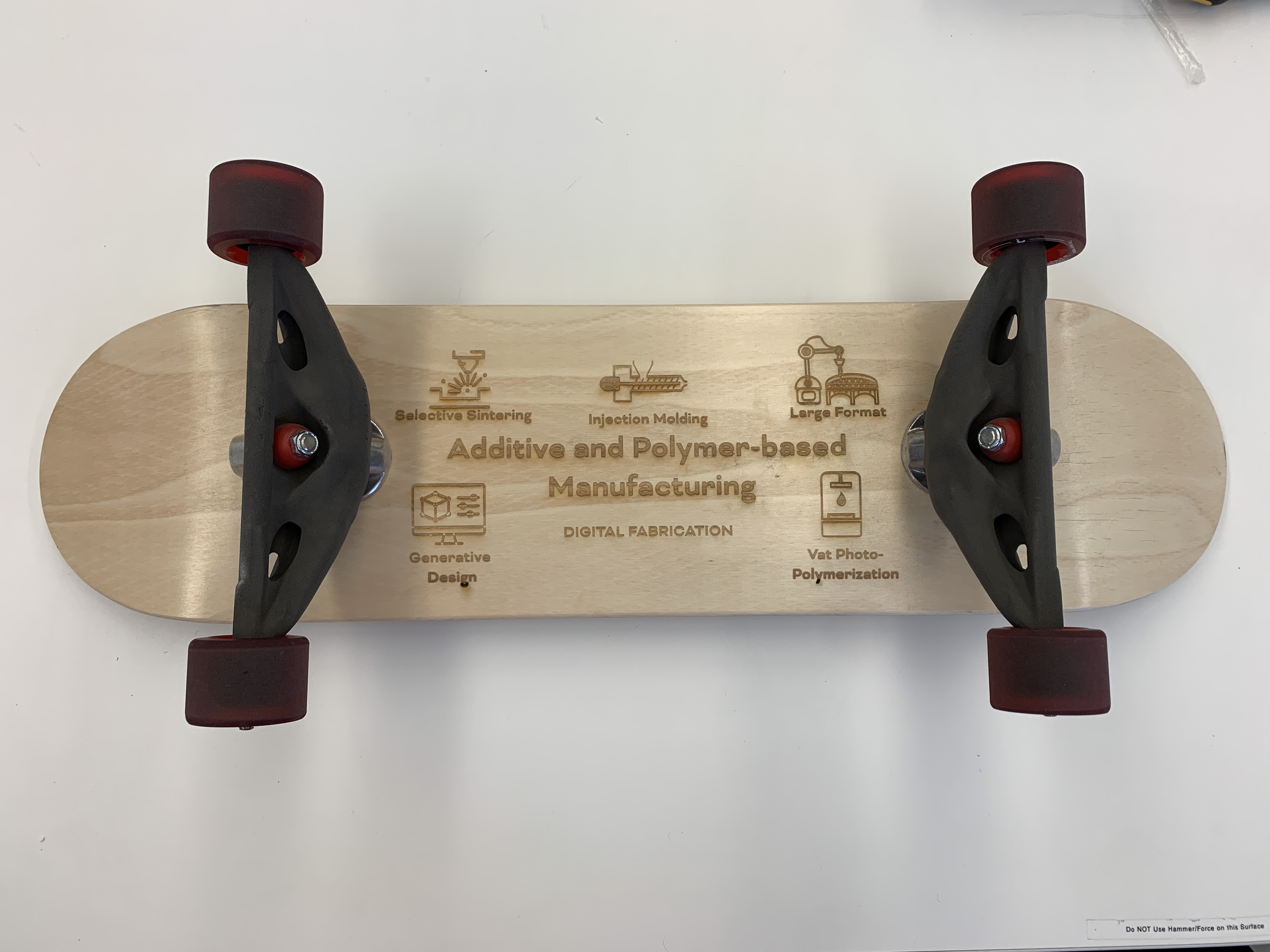
Skateboard Truck Hanger
Description
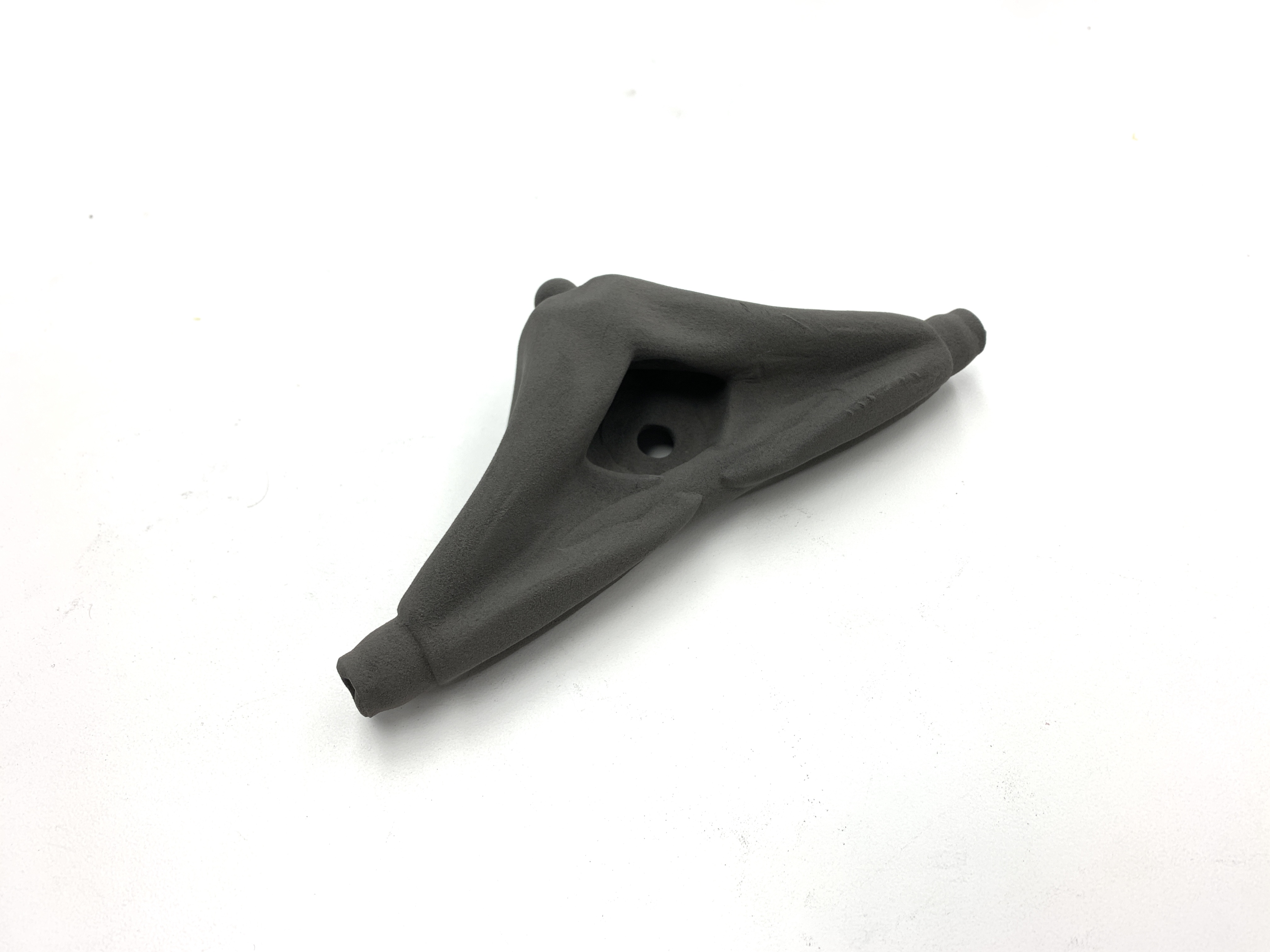
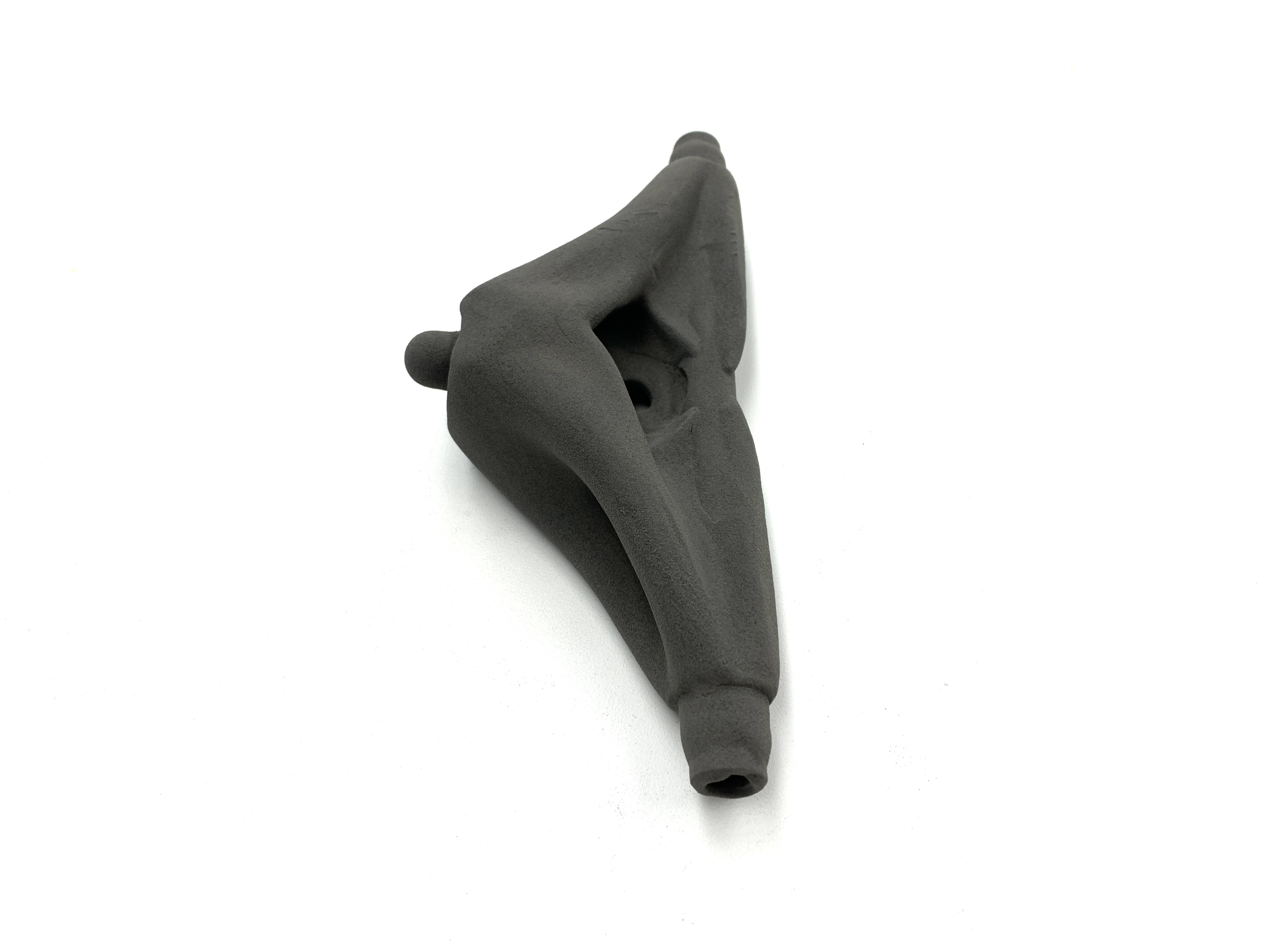
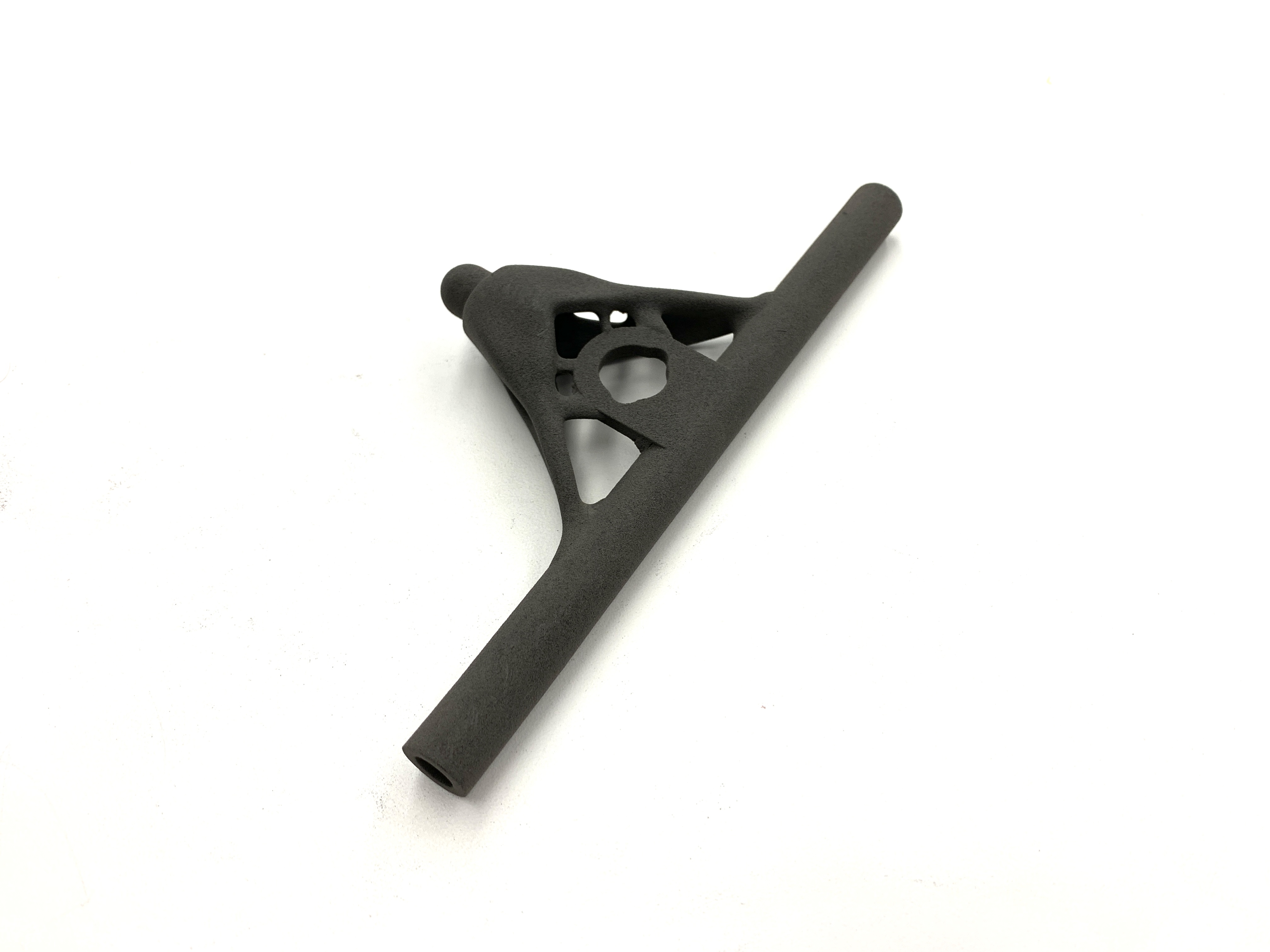
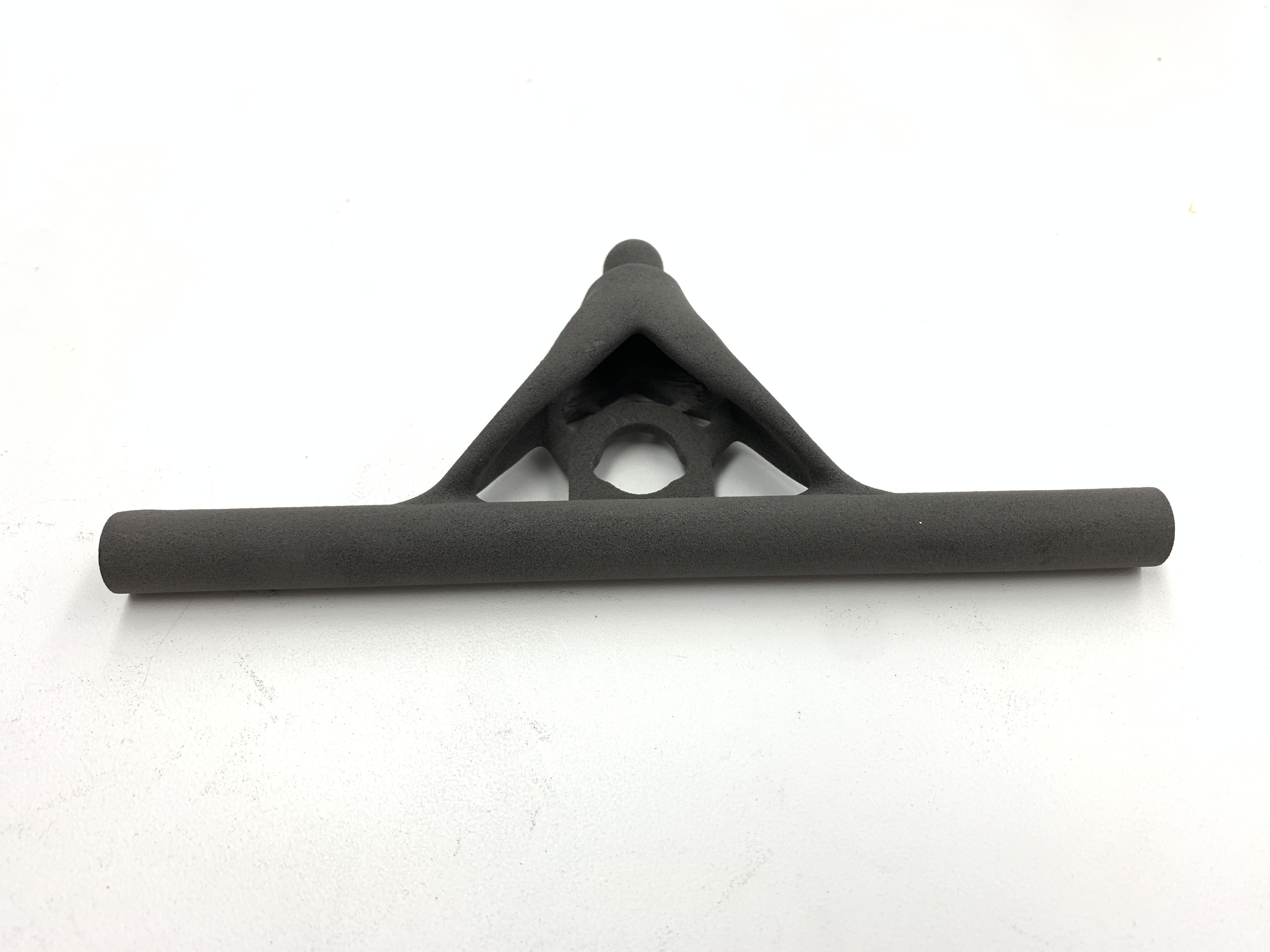
Generative design was used to model a lightweight skateboard truck hanger that was printed on a Fuse 1 SLS powder printer. Generative design outcomes were explored for two different materials: Nylon 12 and AlSi10Mg, a commonly printed aluminum alloy.
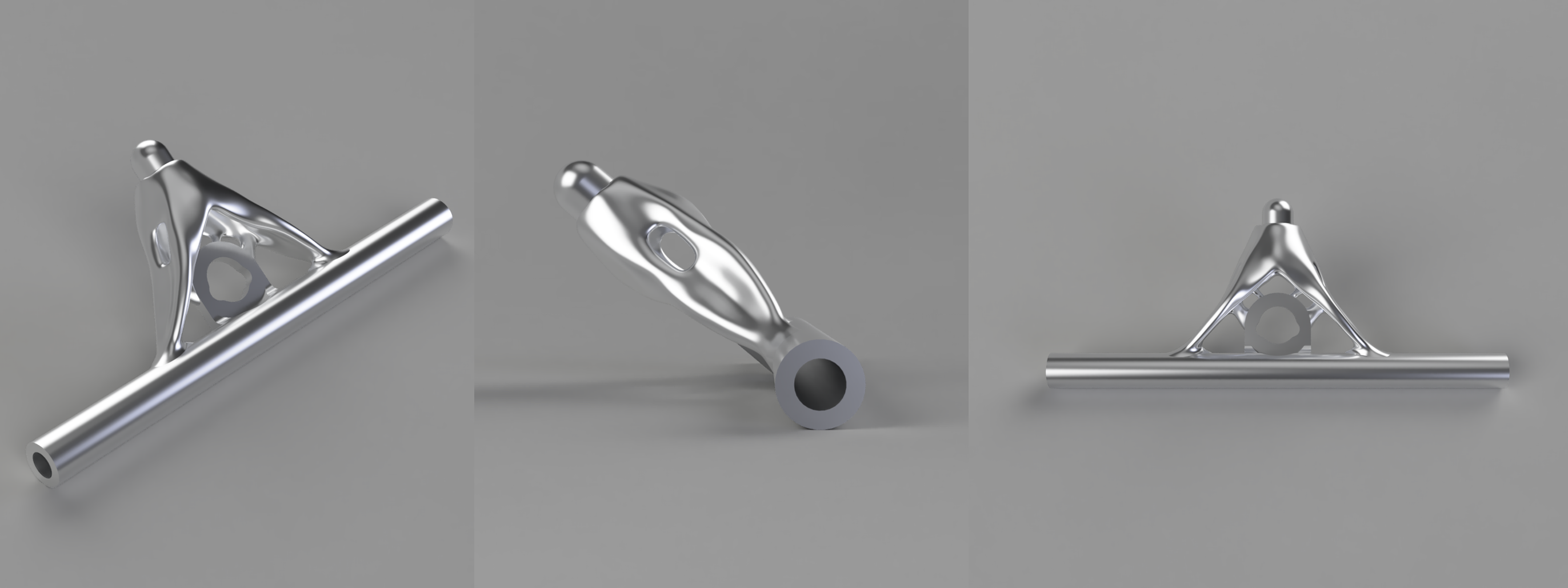 Generated design for AlSi10Mg
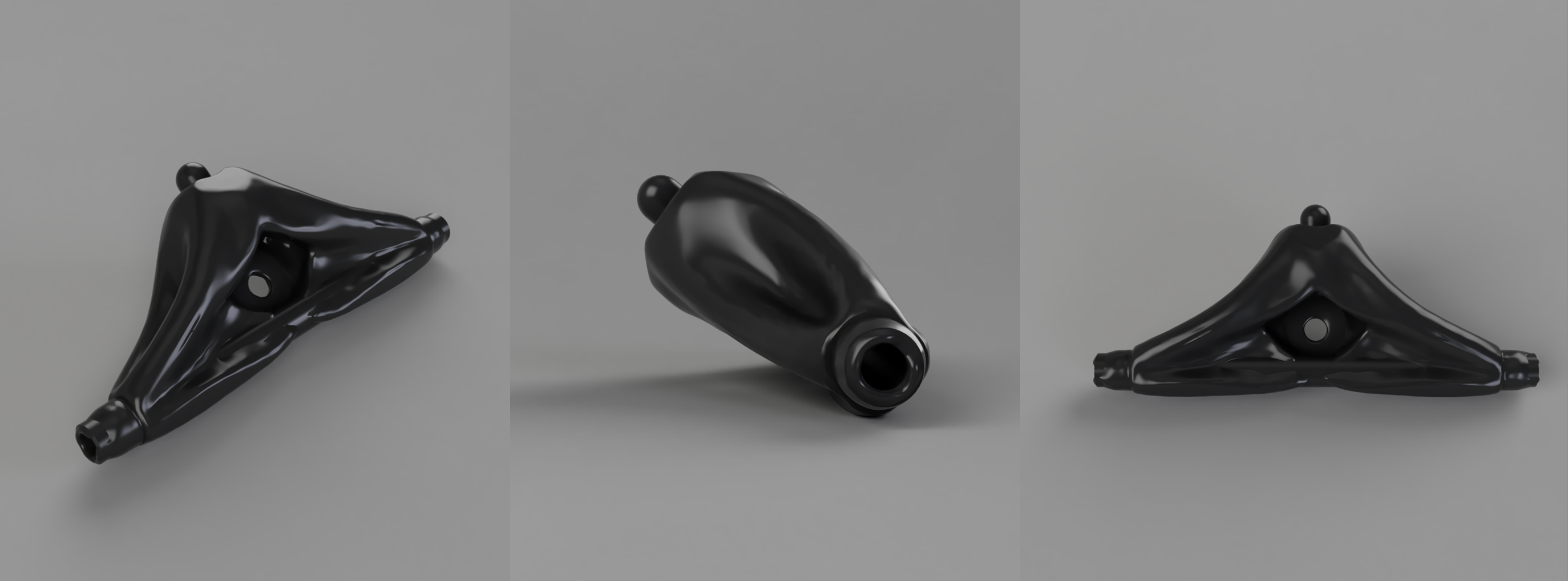 Generated design for Nylon 12
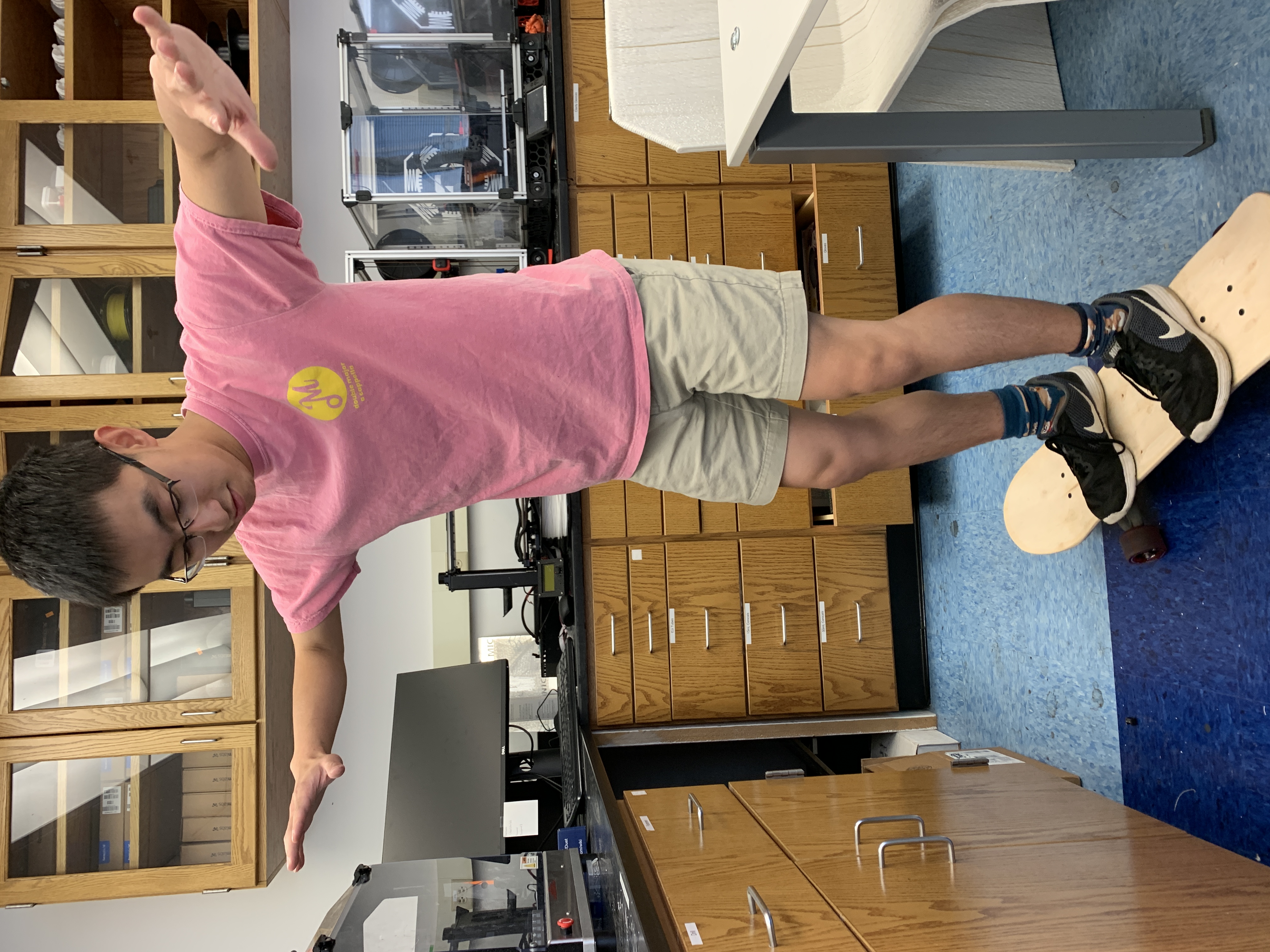 Final skateboard
CAD Model
Aluminum Model
Nylon Model
Background
Generative Design
Generative design (GD) is a design exploration process where various algorithms and artificial intelligence (AI) are used to create various design options based on performance requirements and parameters defined by the user. Through an iterative process, the software is able to evaluate all possible permutations of a given design setup and provide the most ideal solution based on the user parameters. This allows for many parts to be light-weighted, with the generative design process removing unnecessary material while maintaining components that are critical for structural integrity. Additionally, single parts can be created using generative design that replace complex assemblies consisting of many parts.
While generative design can provide extremely significant optimization of parts, there are some potential drawbacks. Since the target constraints and parameters are determined by the user, incorrect application of loads and boundary conditions can lead to results being generated that don’t accurately reflect the necessary environmental conditions that the part in question must withstand. Additionally, it can be extremely computationally intensive to evaluate all the iterations and possibilities for models.
A key drawback of generative design that can be addressed by powder-bed fusion and selective laser sintering is the fact that AI-generated parts are often composed from strange, organic-shaped form bodies that are impossible to create through traditional manufacturing techniques. The generative design process prioritizes meeting the load constraints placed onto it with ease of manufacturing acting as a secondary concern.
Selective Laser Sintering (SLS)
One of the very first commercialized additive manufacturing technologies was powder-bed fusion (PBF), developed in the mid-1980s at the University of Texas at Austin. PBF uses either a laser or electron beam to fuse powdered particles of material together. All PBF processes are layer-by-layer procedures, with fresh powder being spread smoothly on top of previously fused layers. Selective laser sintering (SLS) is a type of SLS where a high-powered laser is used to fuse small particles of powdered material together. The powder, which can be polymer powder (pSLS) or metal powder (mSLS), is heated to just below its melting temperature through radiant- and convection-based heating in the build chamber. The laser the provides the small amount of energy needed to melt the powder while scanning the powder bed surface. As the print bed moves down and each new layer of powder is spread thinly over the previous layers, the laser gradually fuses the powder into a desired 3D geometry.
SLS has several key advantages over other additive manufacturing methods such as SLA and FFF. SLS is known for creating parts that provide some of the strongest mechanical properties of any additively manufactured components. The strength and stiffness of SLS-manufactured parts are comparable to injection molded components, typically regarded as the standard for additively manufactured parts. The part orientation in the print volume is also not critical; there is no need to worry about cupping like in SLA or need for flat geometry on the part to orient on a build plate like in FFF. When the build volume is properly packed with many parts, SLS is one of the fastest additive manufacturing technologies.
Pairing of SLS and GD
One of the biggest advantages that SLS provides is the ability to easily print complex geometries without the need for supports. Since SLS is a layer-by-layer process where the powder bed is recoated each time, the loose unsintered powder is able to act as a self-supporting structure for any material fused above it. This ability to easily print complex, odd-shaped geometries makes SLS an excellent choice for use in conjunction with generative design, which often makes strange, organic shapes that are difficult to manufacture, both with conventional manufacturing techniques like injection molding or CNC machining, and even with other additive manufacturing techniques like FFF. This removes many of the constraints on generative design by allowing the AI to create the most optimal geometries for the given load cases with little consideration for manufacturing constraints.
Additionally, SLS is a versatile technology in terms of compatibility with different materials. While the material used in this skateboard truck hanger project was nylon, SLS can be used with a wide range of materials including other polymers, metals, and ceramics. This gives more possibilities for generative design outcomes and more materials that can be considered for optimizing a design to support load cases. The pairing of PBF technologies with generative design could fundamentally change the role of the engineer in the design process. Freed from many of the constraints of traditional manufacturing techniques, engineers can move their focus from modeling design solutions to refining and setting up the generative design environment that can use digital tools to create an optimized solution.
Applications
Together, technologies like SLS and generative design have vast applications that can improve work flow and end results tremendously, particularly in the aerospace and automotive fields. A key ability of using generative design in conjunction with SLS is the ability to lightweight parts. This is directly correlated to performance efficiency in the aerospace field, particularly for aircraft and spacecraft when strength and stiffness are able to be maintained when weight is reduced through generative design. The ability to rapidly prototype and manufacture components has been widely taken advantage of in the aerospace field, particularly for testing spare parts in engines, prototyping various aircraft components, molding turbocharger impellers and blades, creating truss lattices for wings, and more. Similarly, the combination of generative design and SLS has been extremely valuable in the automotive industry as well. Nilesh Dale, senior manager of Advanced Materials and Technology Research at the Nissan Technical Center North Ameraica, pointed out that “in addition to quick prototyping, the main benefit we have seen [from additive manufacturing technologies] is actually the combination of two technologies: generative design and 3D printing, which offer lightweighting”. Through the use of new metal alloys and composites, generative design and SLS have been used in the automotive field to simplify assemblies found throughout vehicles into more optimized lightweight parts.
References
- https://www.lboro.ac.uk/research/amrg/about/the7categoriesofadditivemanufacturing/powderbedfusion/
- https://formlabs.com/blog/what-is-selective-laser-sintering/
- https://commons.erau.edu/cgi/viewcontent.cgi?article=1708&context=ijaaa
- https://www.additivemanufacturing.media/articles/automotive-tech-center-sees-benefits-and-challenges-of-am
- https://commons.erau.edu/cgi/viewcontent.cgi?article=1708&context=ijaaa
- https://reader.elsevier.com/reader/sd/pii/S0264127521005633?token=B1CD861B0A78ECE7BBFAEA1E256A86E26AC1733D328AB2C3E0E341E4AF16041D4A464FF67EE20F0605062D67A4BF0E6C&originRegion=us-east-1&originCreation=20230428014505
Generative Design Setup
Design
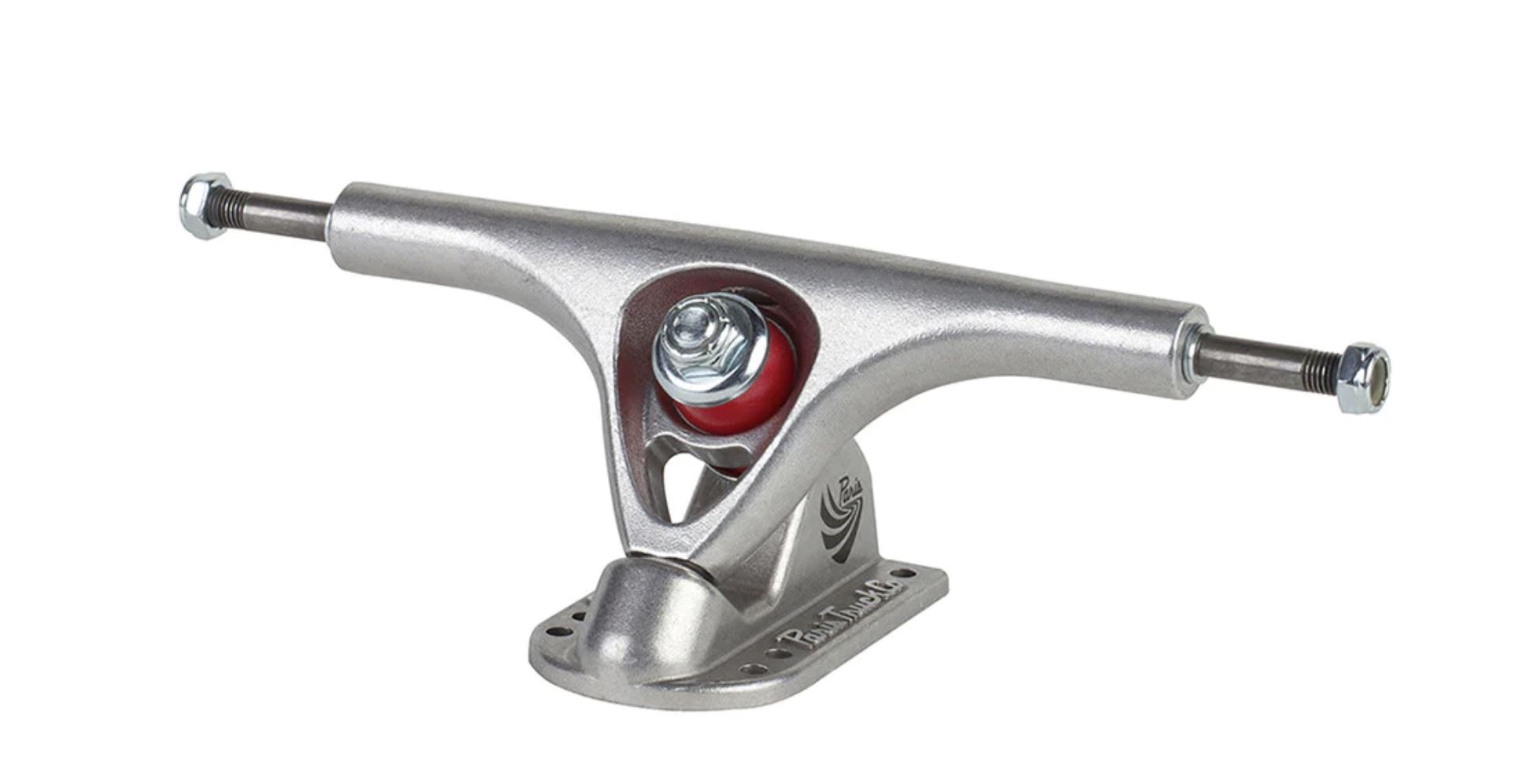
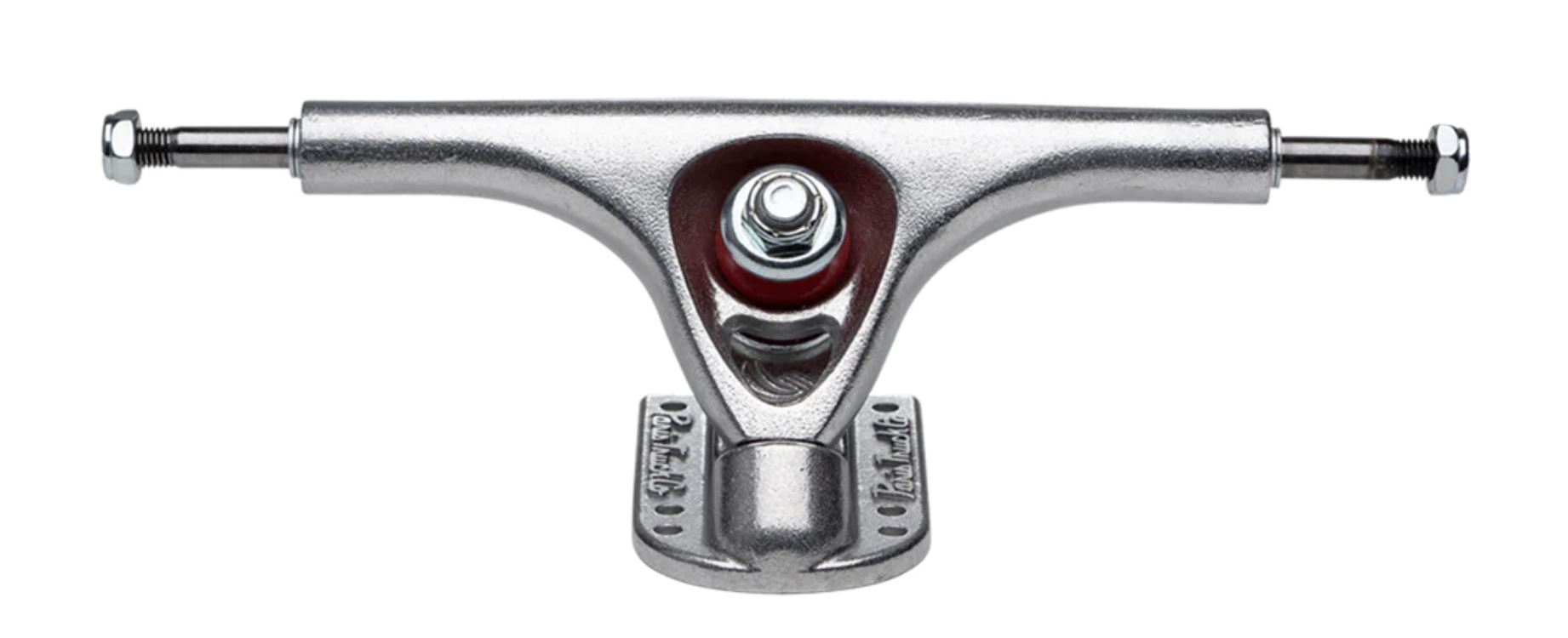 Original Paris V2 180MM skateboard truck.
- The skateboard hanger was modeled based on a Paris V2 180MM 50º RAW skateboard truck
- The hanger serves to connect the axle to the baseplate of the skateboard
- This includes connections to the kingpin and pivot cup, both of which aid the rider in turning on the skateboard
Preserve Geometry
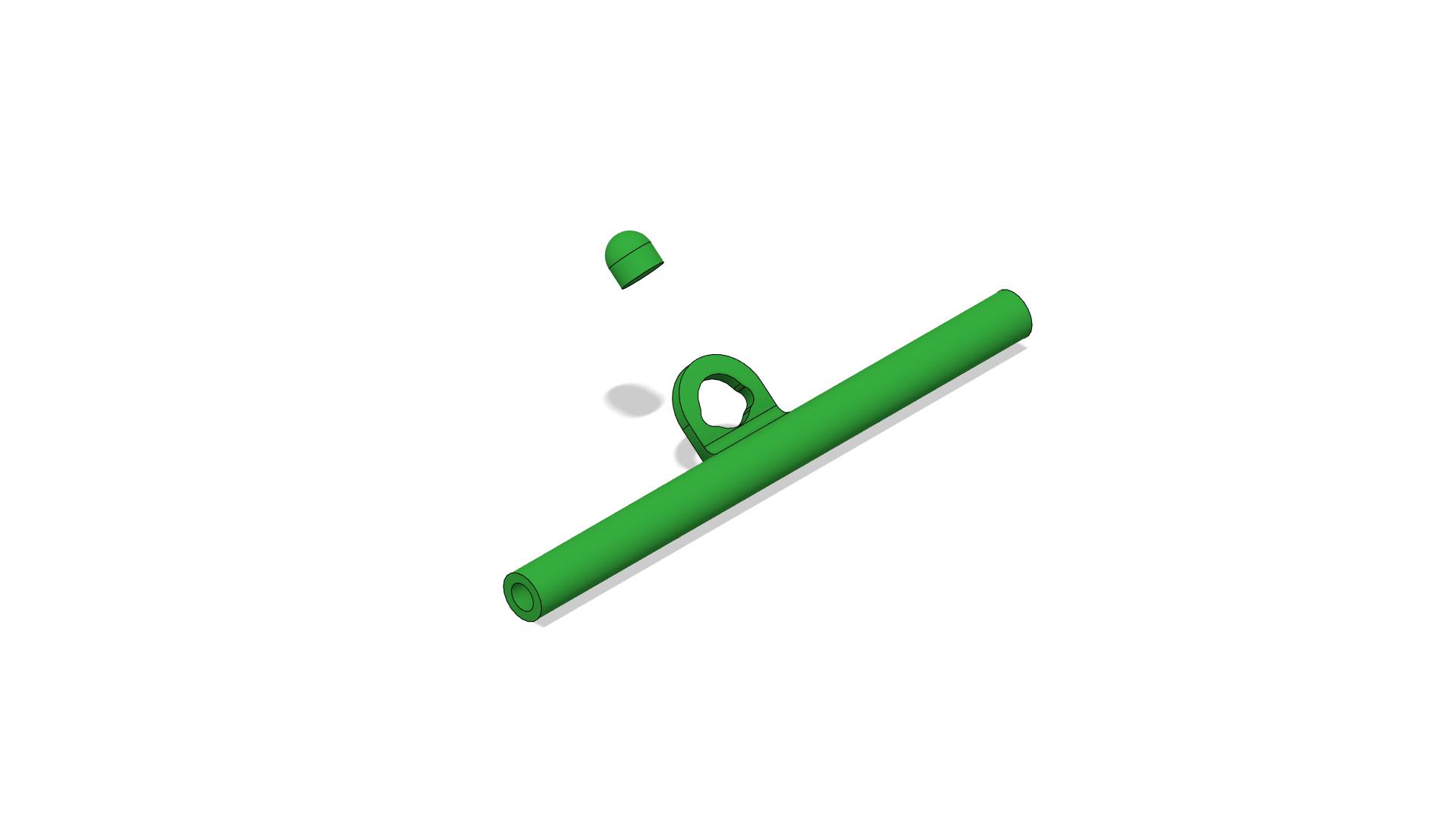 Preserved geometry for the generative study.
- To setup the generative design for the skateboard, several areas were designated as preserved geometry
- These are bodies that are incorporated into the final design shape but are not manipulated
- This included the axle and mounting locations for the kingpin and pivot cup
Obstacle Geometry
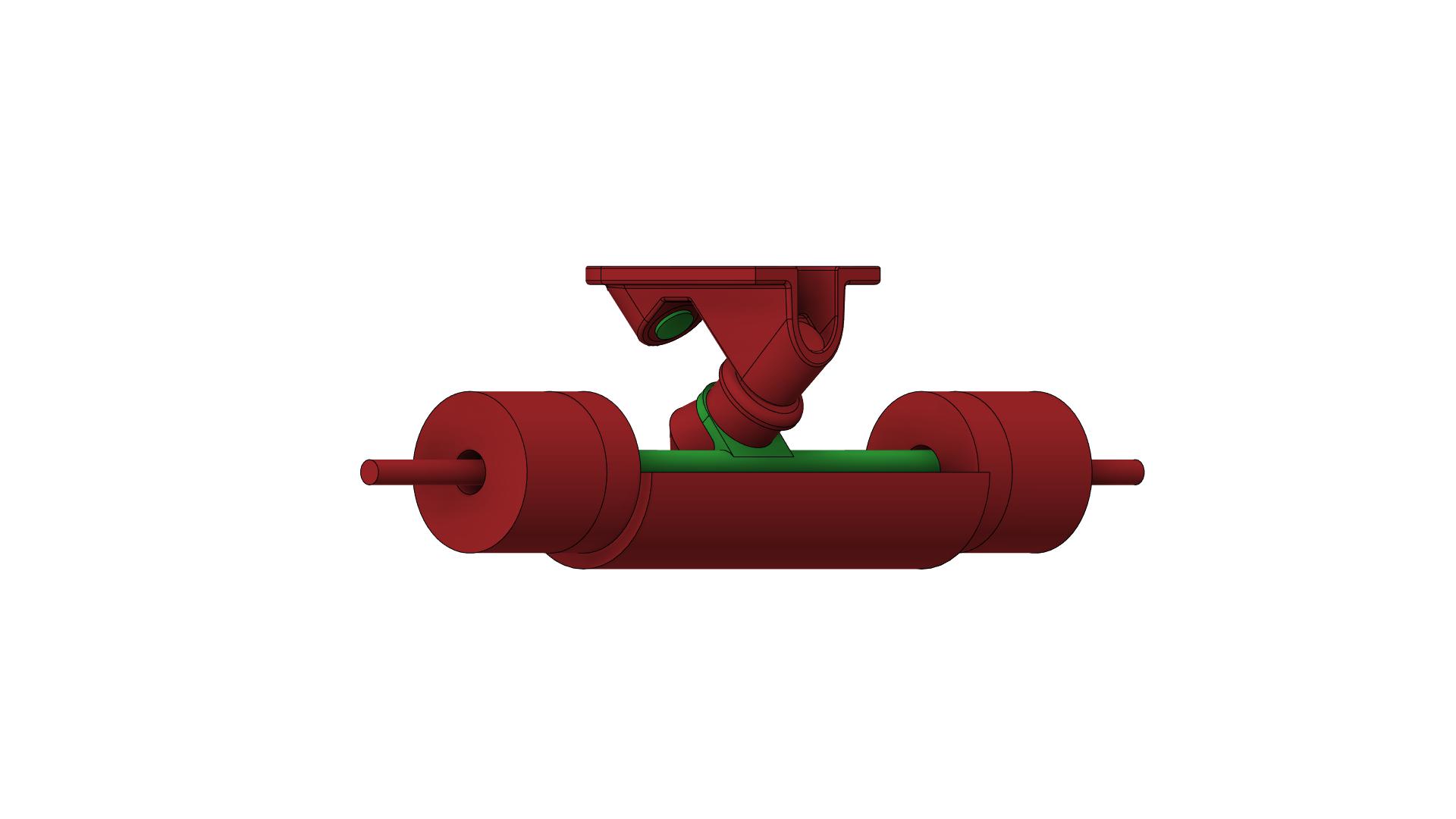
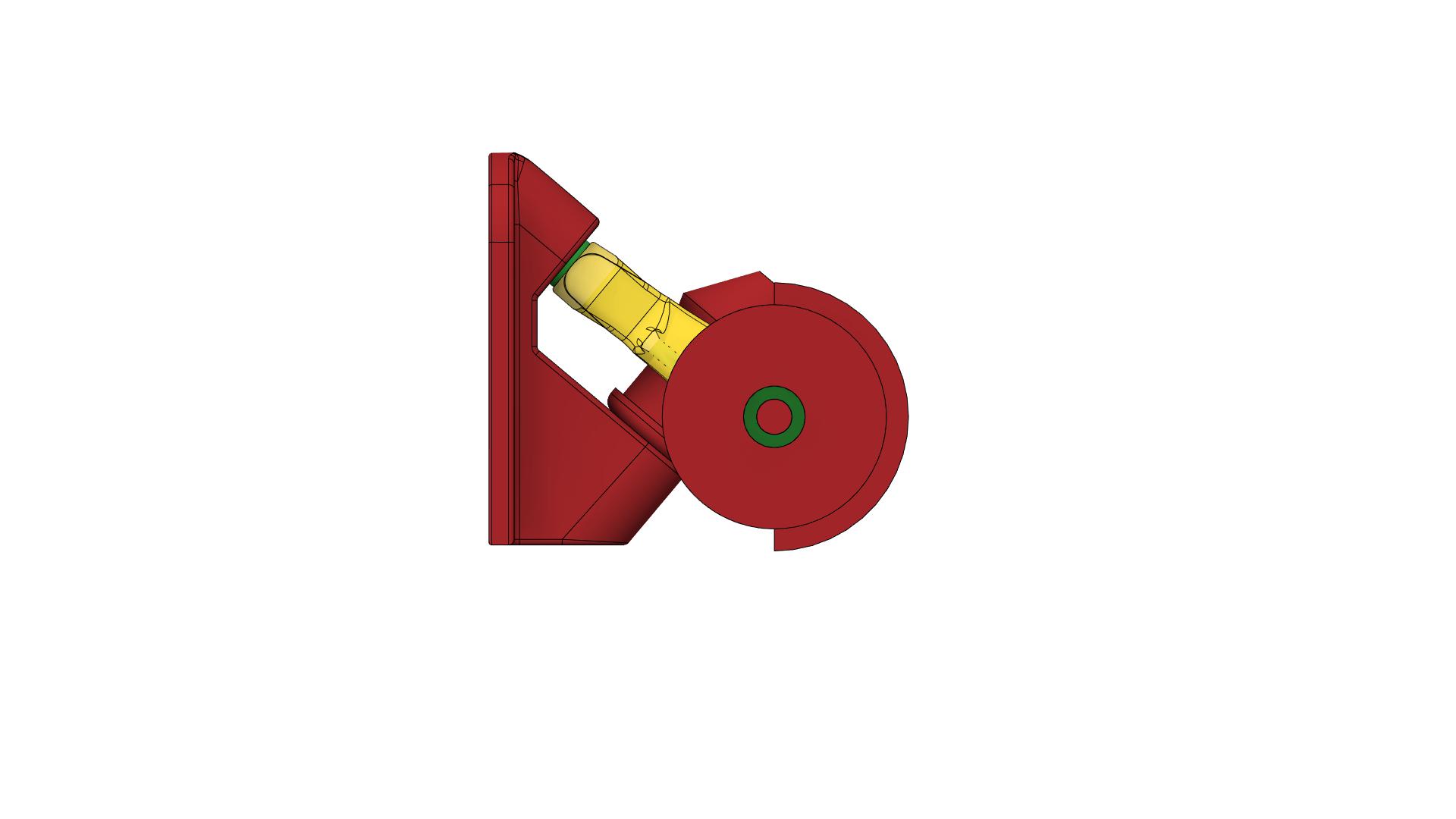
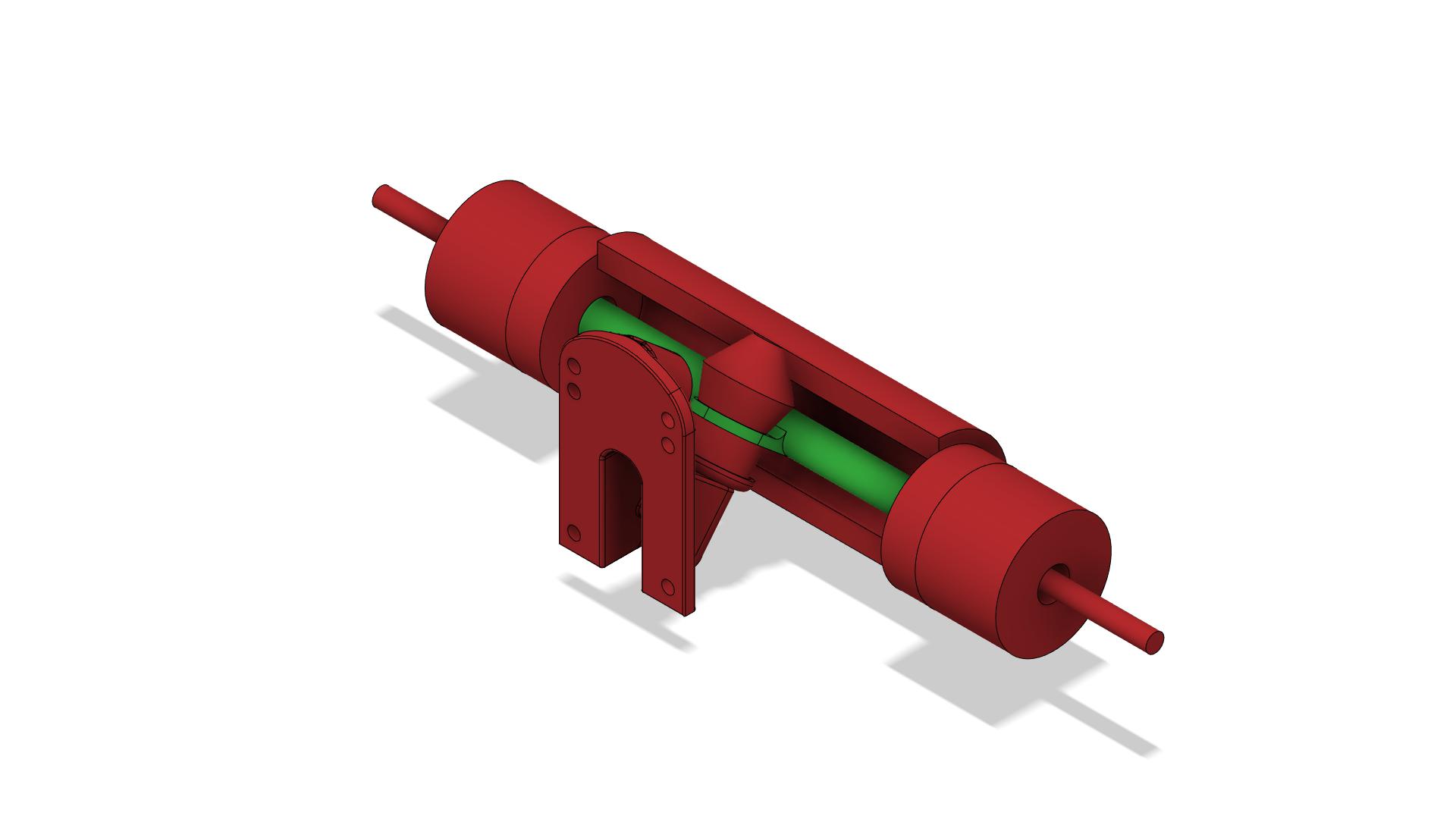 Obstacle geometry for the generative study.
- Additionally, several areas were designated as obstacles where no material should be placed in the general design
- “Empty space” in the final generated design
- To fit the axle (diameter = 8 mm), an 8.1 mm diameter obstacle was created through the axle geometry as a cutout
- Obstacles were created at each end of the axle to ensure plenty of clearance for 2 in diameter wheels
- An obstacle was also created around the axle to ensure enough clearance between the hanger and the ground for the wheel to touch and spin
- Since the skateboard wheels used 608ZZ bearings, obstacles were created to constrain the part of the hanger touching the wheel/bearing to be no larger than 17 mm in diameter
Starting Geometry
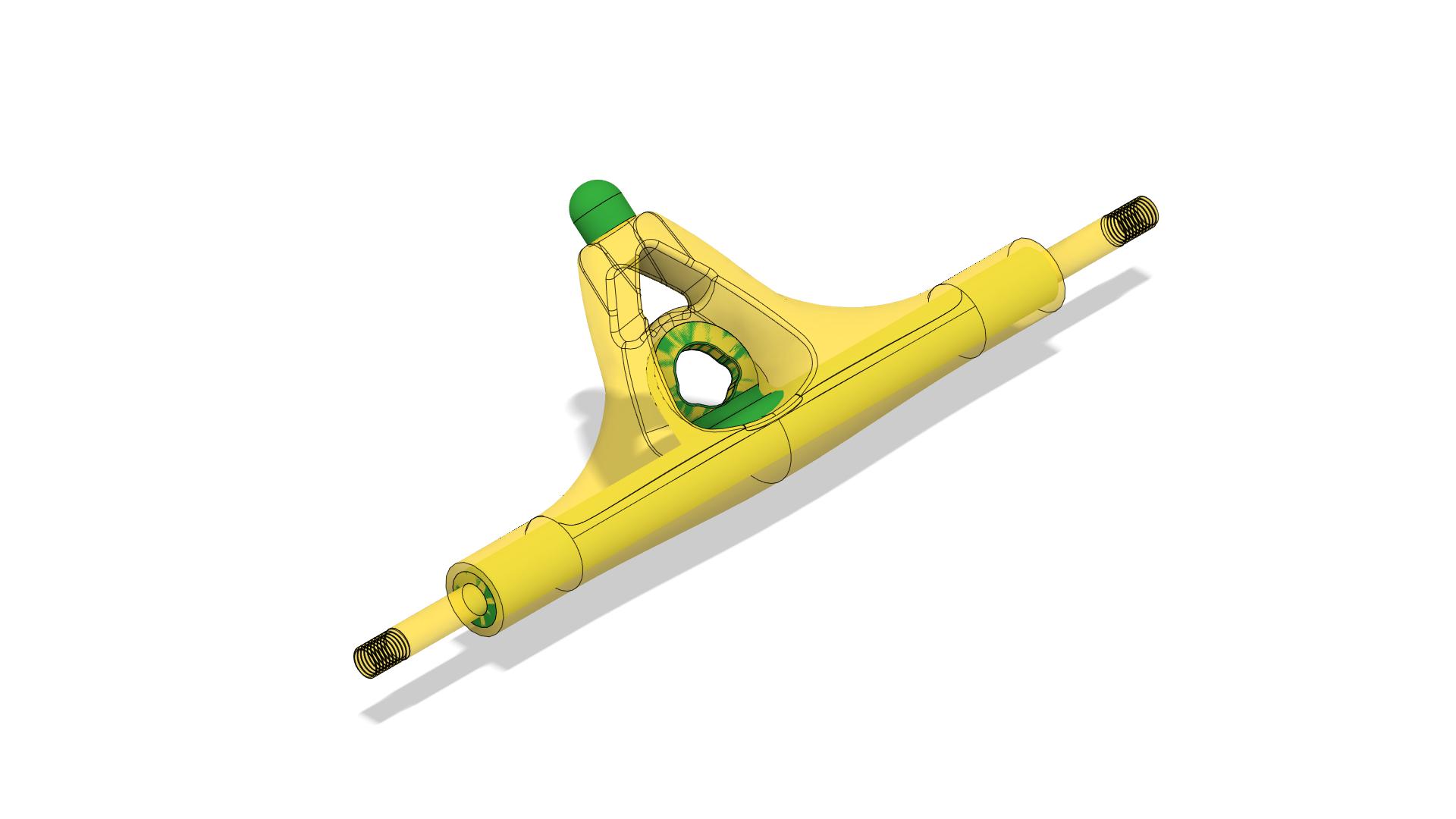
 Starting geometry for the generative study.
- The original shape of the Paris V2 truck was set as the starting shape of the generative study
- This provides the software with a starting point to generate outcomes from, decreasing computation time
Loads and Constraints
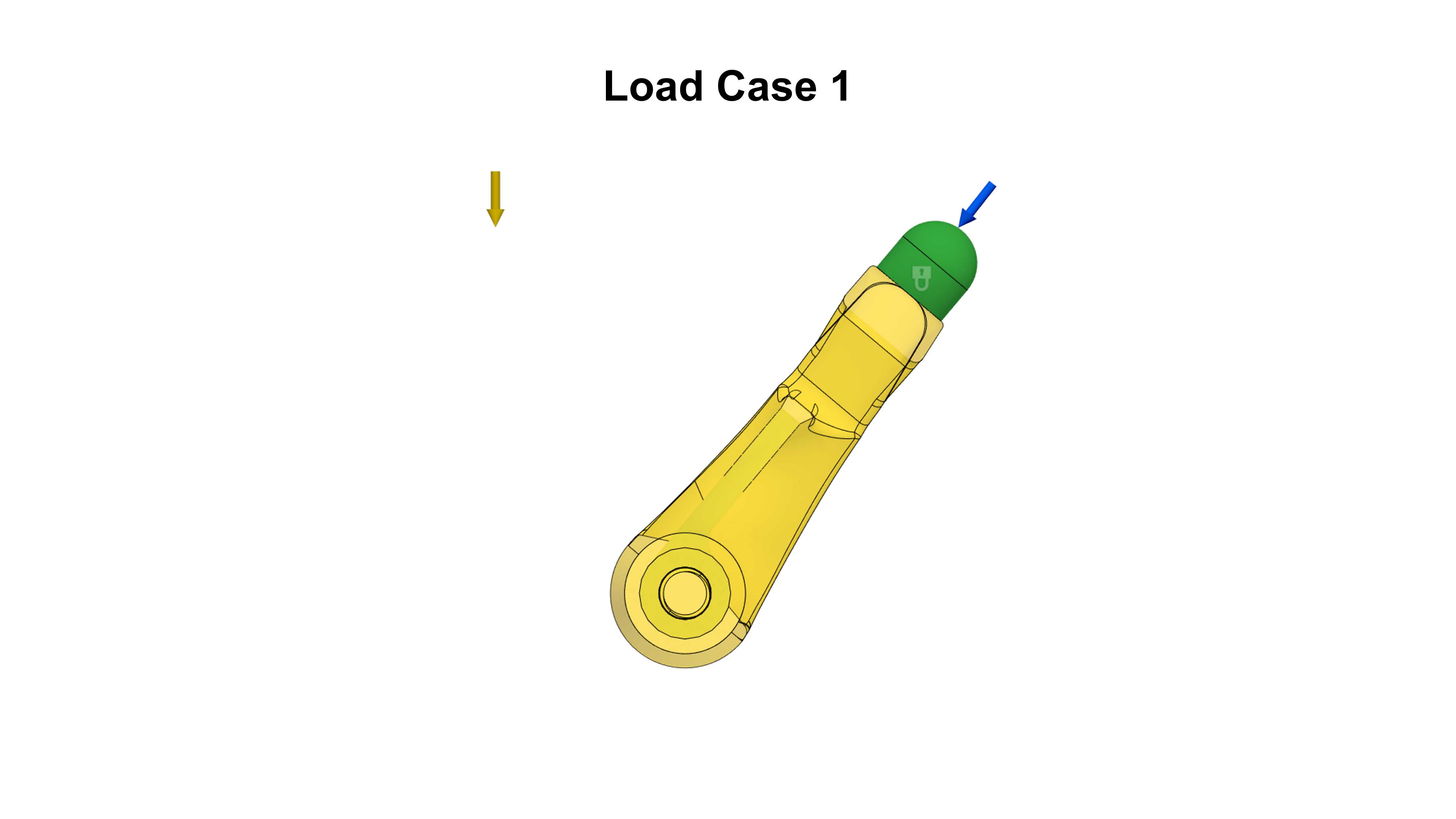
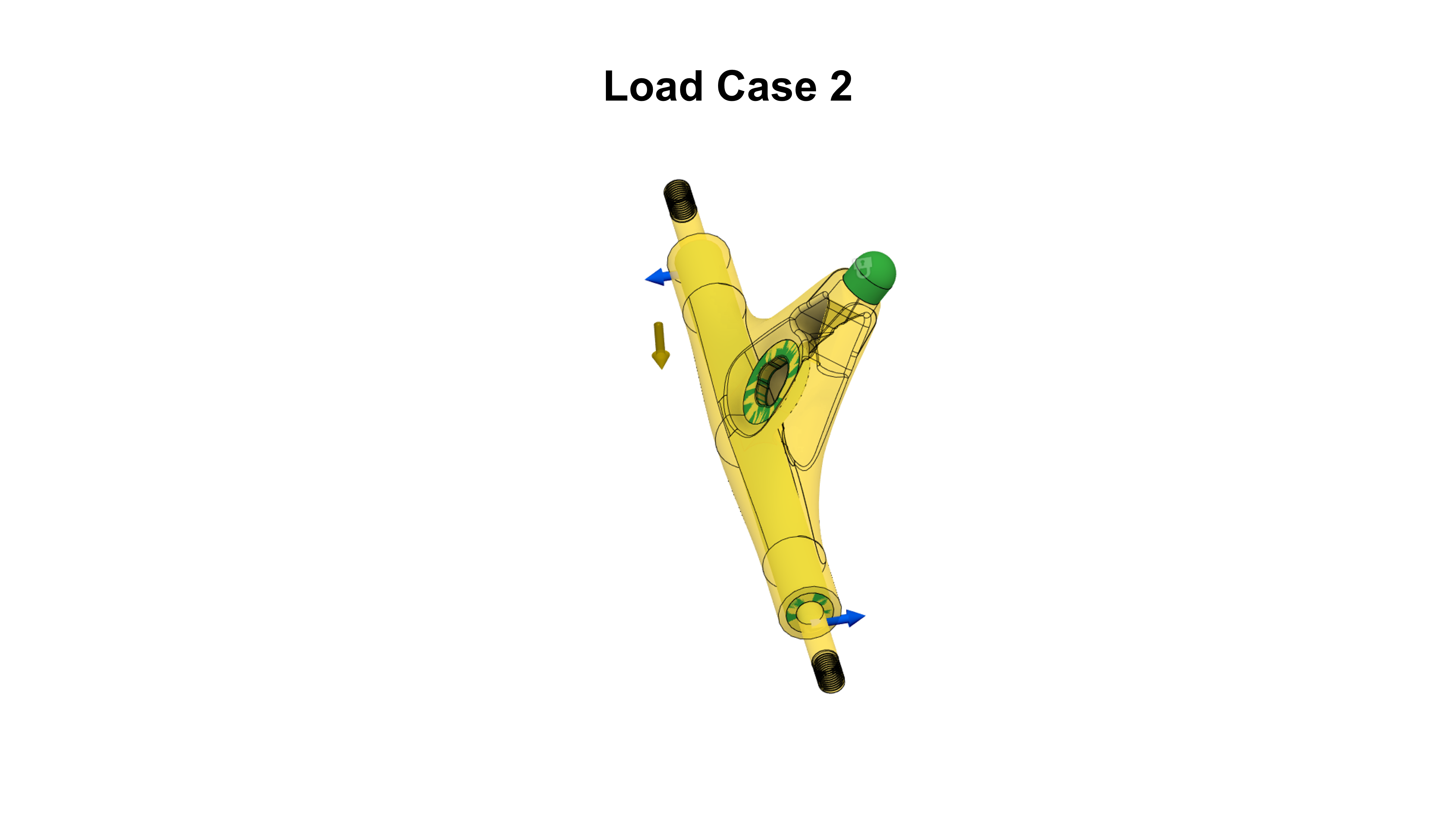
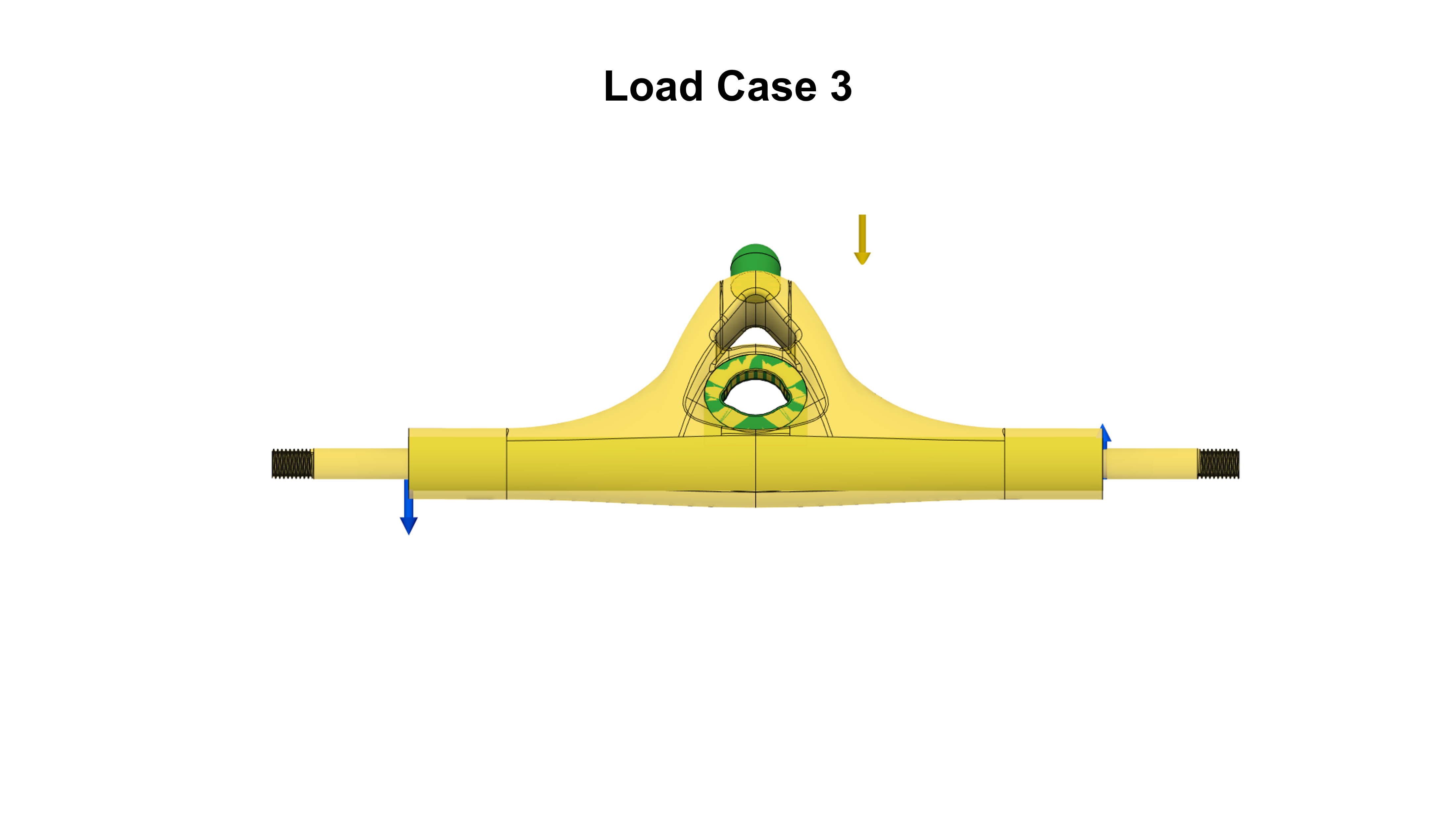 Load cases applied to the podium.
- A fixed constraint was placed on the ball-shaped connection to the pivot cup
- This constrained the hanger in the x, y, and z directions
- Three load cases were considered in the generative design. Different loads were considered for the Nylon 12 material than the AlSi10Mg material in order to achieve convergence on the generative model
| Load Case | Description | Magnitude for AlSi10Mg | Magnitude for Nylon 12 |
|---|---|---|---|
| 1 | Normal load | 200 lb-force | 150 lb-force |
| 2 | Vertical twisting force | 200 lb-force total (100 lb-force per side) | 150 lb-force total (75 lb-force per side) |
| 3 | Horizontal twisting torque | 200 lb-force total (100 lb-force per side) | 150 lb-force total (75 lb-force per side) |
Design Criteria
- The generative design objective was set to “Minimize Mass”
- Additive manufacturing in all 6 directions (X, Y, and Z in the + and - directions) were evaluated as well as an unrestricted manufacturing case
- The final models selected for each material was the unrestricted manufacturing case
- An overhang angle of 45 degrees and a minimum thickness of 1.50 mm were considered
- A safety factor of 2.0 was used for the AlSi10Mg material while a safety factor of 1.0 was used for the Nylon 12 material