
HapiMask
Summer 2020
Problem
- After the start of the COVID-19 pandemic, face masks became a necessity for controlling the spread of viral particles and maintaining public safety.
- This new standard significantly minimized the quality of personal interactions between mask wearers
- Research suggests that when portions of a face are obscured, people confuse social judgments related to the face (i.e., if the face looks attractive, approachable, trustworthy, intelligent), have difficulty discerning feelings and overall mood, and rate those faces as being less happy.
- These studies also suggest that covering the mouth and cheeks via mask wearing will significantly alter and decrease the quality of human social interaction.
Solution
- To solve this issue, a group of friends and I developed HapiMask, a unique mask solution that enhances the quality of social interaction without compromising the safety of mask wearers and those around them.
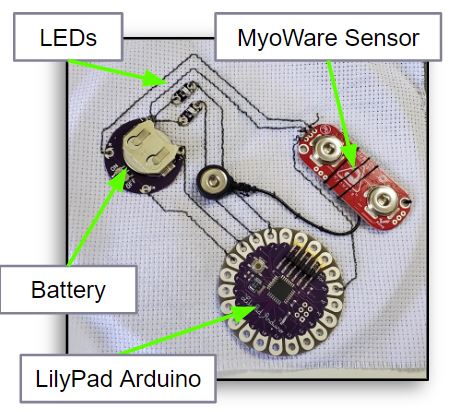
- Our mask prototype used an electromyography (EMG) sensor placed on the cheek of the mask wearer to detect when the user smiled and then emitted a soft LED glow in response.
- An Arduino Lilypad, conductive thread, and other textile electronics were used to make this positive emotion-displaying component, which was easily removable to allow for reusability.
Video
Team
Andy Du, Vanderbilt School of Engineering, Mechanical Engineering
Kaelon McNeece, Vanderbilt School of Engineering, Mechanical Engineering
Seok Hee Hong, Vanderbilt School of Engineering, Computer Science
Minna Apostolova, Vanderbilt College of Arts and Sciences, Biochemistry