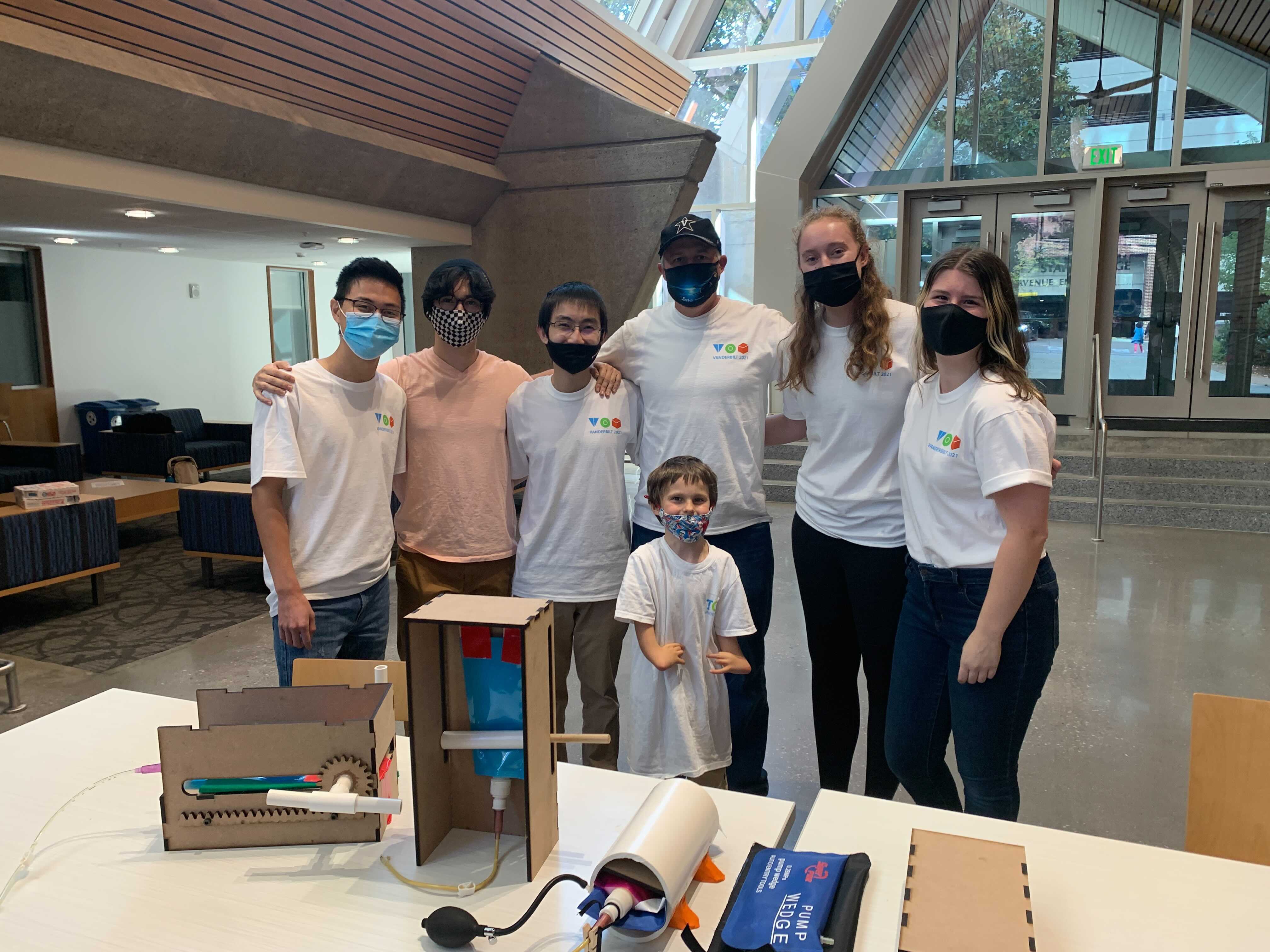
Independent Feeding Tube Device
Fall 2021
- This project was completed as part of the 2021 Vanderbilt Tikkun Olam Makers (TOM) Makeathon, an annual event where engineering teams are paired with “need-knowers” from the Nashville community to create assistive device for disabled children over the course of a weekend.
- Winner of the Scott Carlton Community Award from the Tikkun Olam Makers Global Abraham Accords competition for exemplifying empathy, community, and humanity in this project.
Problem
- Hugh Lang, son of Dr. Matthew Lang at Vanderbilt University, is a 7-year-old boy who suffers from a condition called radial dysplasia where he has clubbed hands with only four fingers located near his elbows.
- This results in him having limited use of his hands for fine motor skills and makes typically ordinary tasks like putting clothes on and opening doors very difficult.
- Hugh also consumes a completely liquid diet through a feeding tube, and due to his radial dysplasia condition, he is currently unable to feed himself.
- He relies on an adult to inject his liquid food into his feeding tube through a manual syringe.
- This has resulted in Hugh not having control over the rate he is fed and has also led to him getting rejected from schools due to his inability to feed himself.
- An easy, low force solution that allows Hugh to feed himself was needed.
- Because of his clubbed hands, the device needs to be easily manipulated and stable enough so that he can use it on his own.
Video
Solution
- Our team developed several potential solutions to enable Hugh to feed himself through his feeding tube.
- I focused on two main designs:
- A rack and pinion mechanism connected to a roller pin that slowly pushed the liquid food out of a plastic pouch and into the feeding tube
- A syringe pump design powered by a manual crank
- Both designs used laser cut pieces of MDF designed in AutoCAD as well as a few 3D printed parts designed in SOLIDWORKS
Rack and Pinion
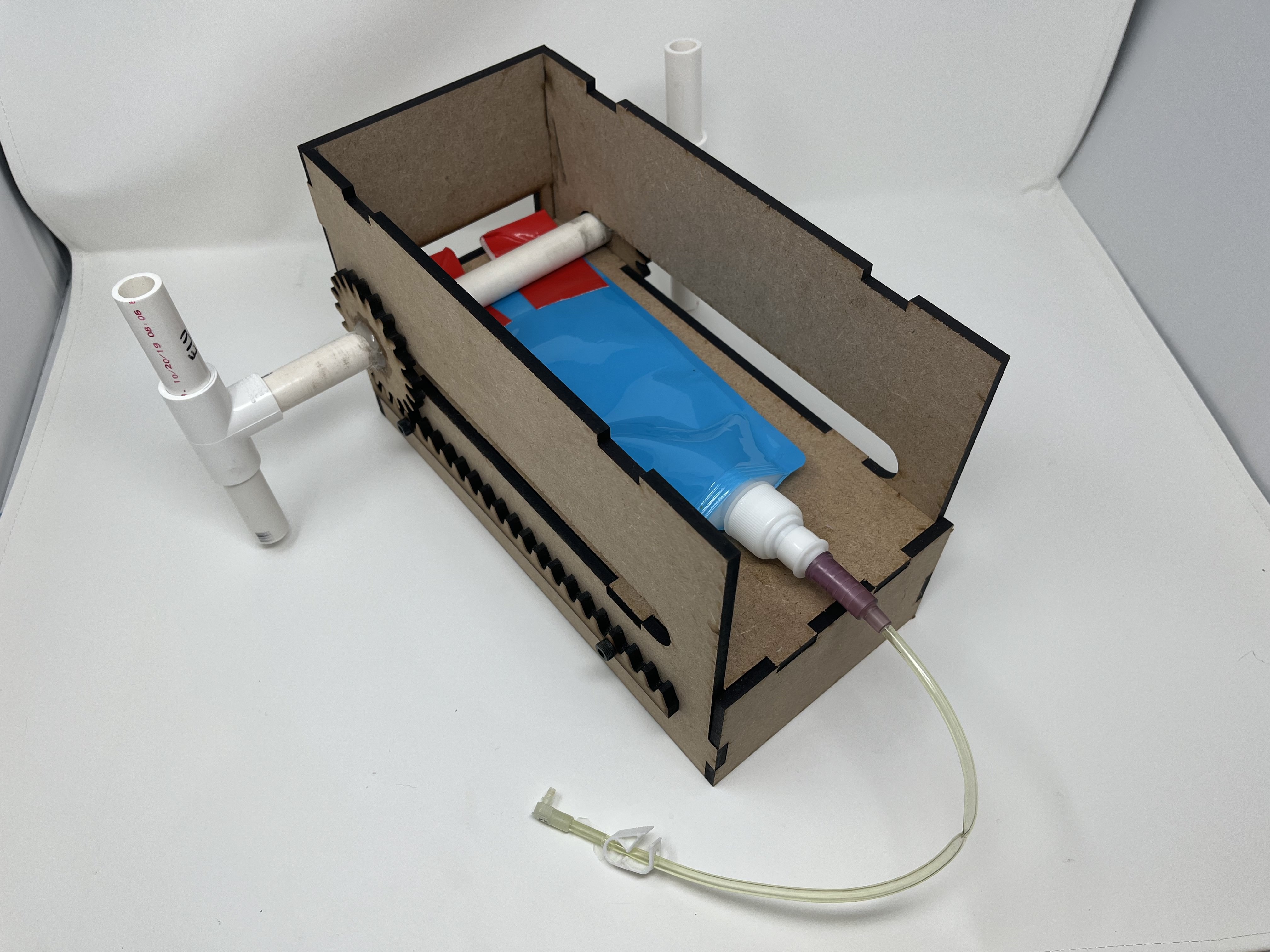
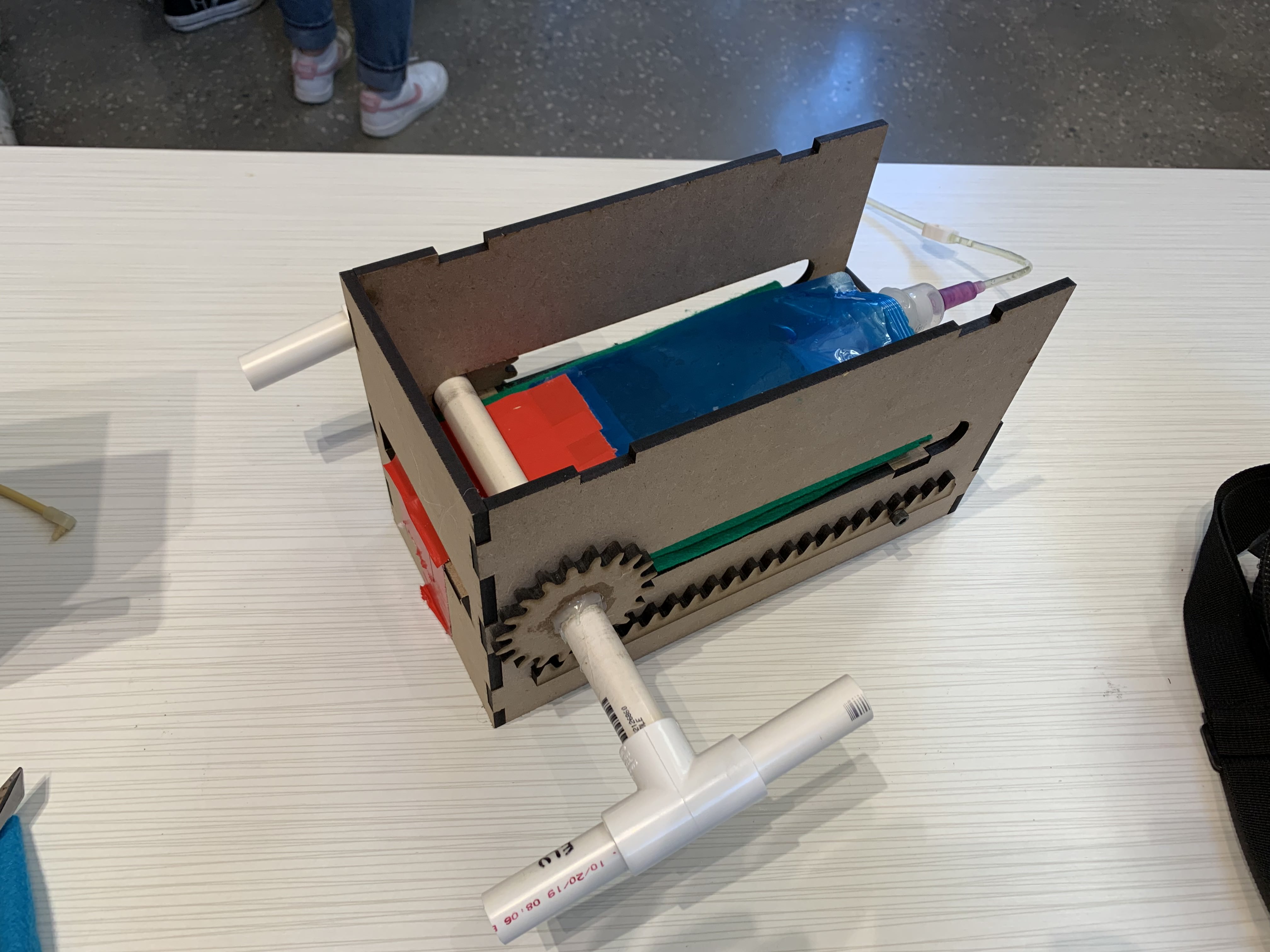
- A roller pin is connected to a rack and pinion mechanism found on the outside of the device
- The food bag is secured to a base plate such that when the roller pin is turned and it translates along the track of the rack and pinion mechanism, the food inside the bag is pushed forward and into the feeding tube
- The lever arms of the handles as well as the gear ratio of the rack and pinion mechanism were optimized such that the force required to push food out was as low as possible so that Hugh could operate it himself
Syringe Pump
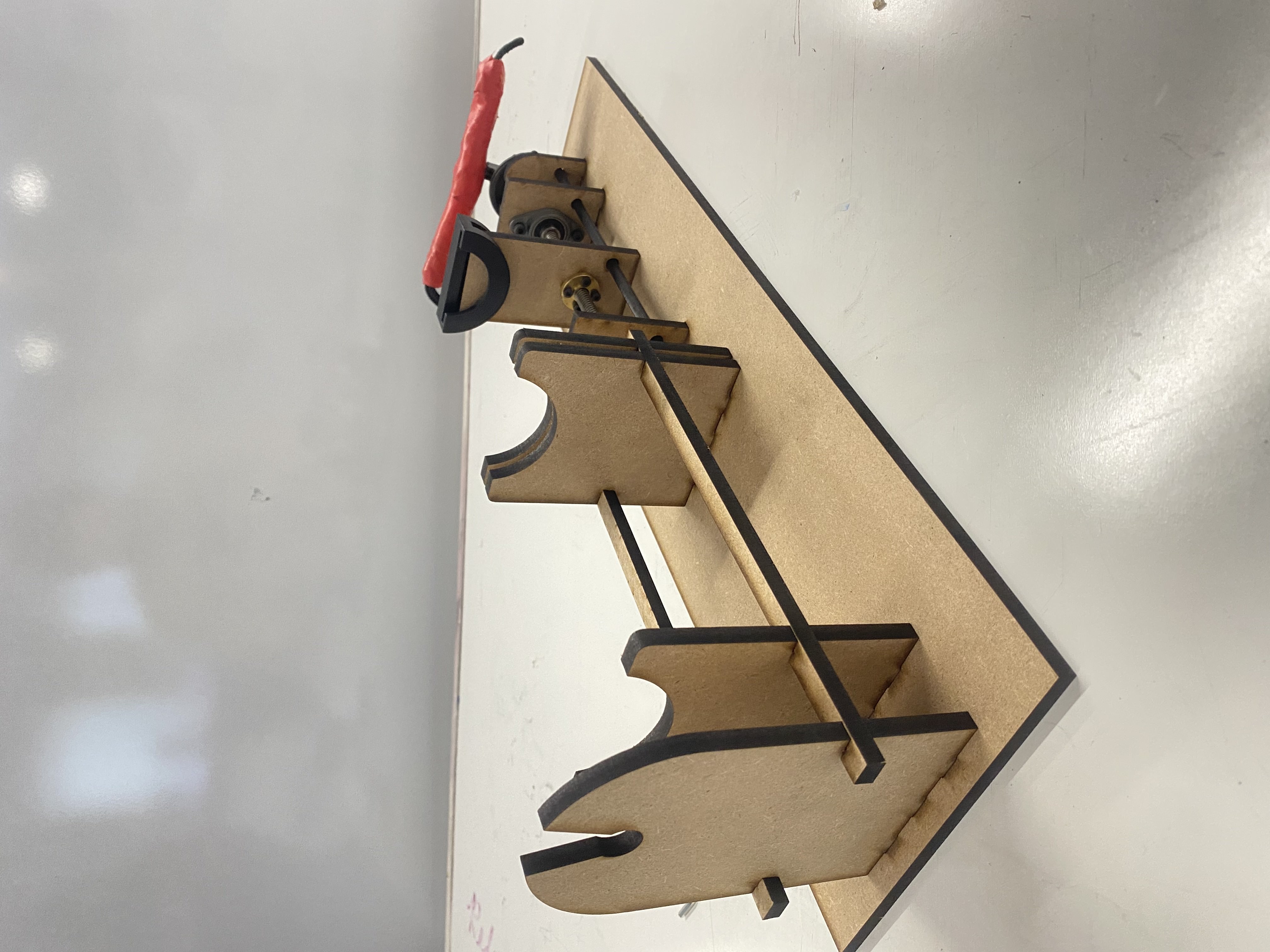
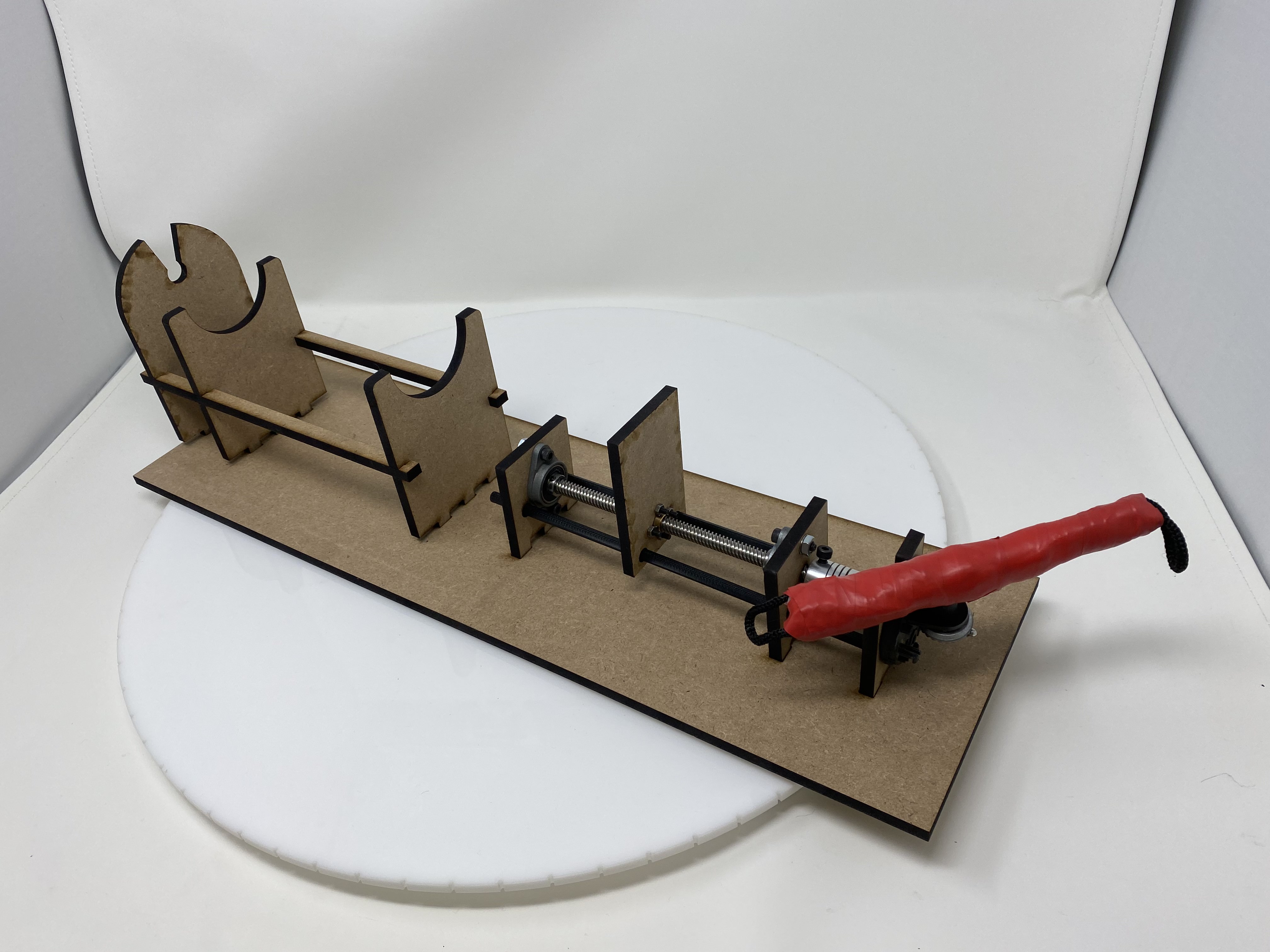
- A crank mechanism and worm gear converts rotational motion from the horizontal plane to the vertical plane
- The crank includes a lever arm to make it easier for Hugh to turn, and also has loops on the ends so that Hugh would be able to loop his pinkies through
- The worm gear is connected to a flexible coupler to correct for any misalignment, and the coupler is connected to a lead screw
- As the lead screw turns, the nut converts the rotational motion into translation, pushing the syringe plunger forward
- A 3D printed clip allows the syringe plunger to be locked into the plunger holder
- As the crank turns, the plunger holder moves forward, pushing food out of the syringe and out the feeding tube
Team
Andy Du, Vanderbilt School of Engineering, Mechanical Engineering
Samuel Torres, Vanderbilt School of Engineering, Mechanical Engineering
Luke Kim, Vanderbilt School of Engineering, Mechanical Engineering
Eliza Hill, Vanderbilt School of Engineering, Chemical Engineering
Erica Guelfi, Vanderbilt School of Engineering, Biomedical Engineering
Chey Sirota, Vanderbilt School of Engineering, Mechanical Engineering